Consistent symmetry representations, layer-wise factor separation, and slot attention under continual learning.
A second line of work, carried out with colleagues at the IRR Lab, asks how factors of variation should be organized inside a network so that representations generalize compositionally and survive sequential training.
Consistent representation of identical transformations. Symmetry-based VAEs can encode the same semantic transformation differently depending on the sample pair. Mapping latent vectors to a bijective cyclic representation via the Cayley transform, with a fixed-grid codebook, restores this consistency and improves disentanglement and compositional generalization (Jung et al., 2026).
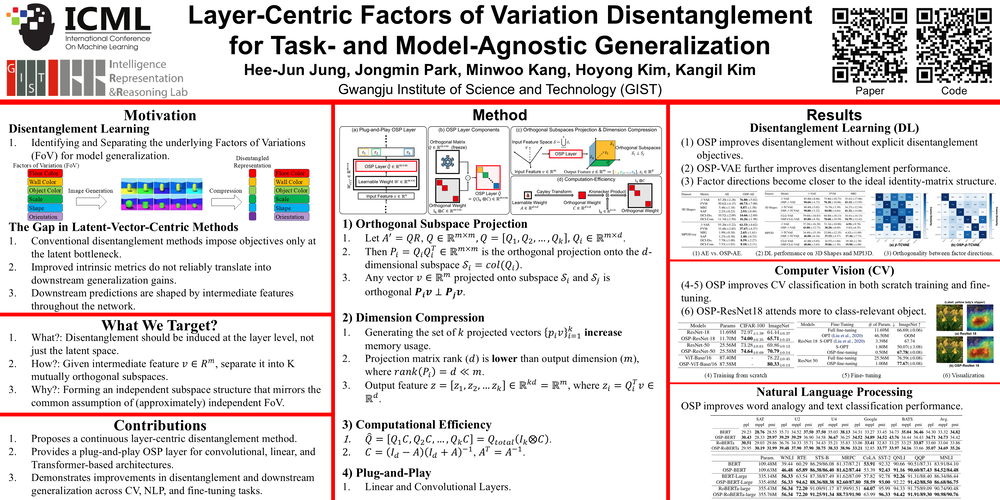
Layer-centric disentanglement. Instead of constraining only the latent bottleneck, the Orthogonal Subspaces Projection layer separates factors inside intermediate layers and improves downstream generalization across vision and language tasks (Jung et al., 2026).
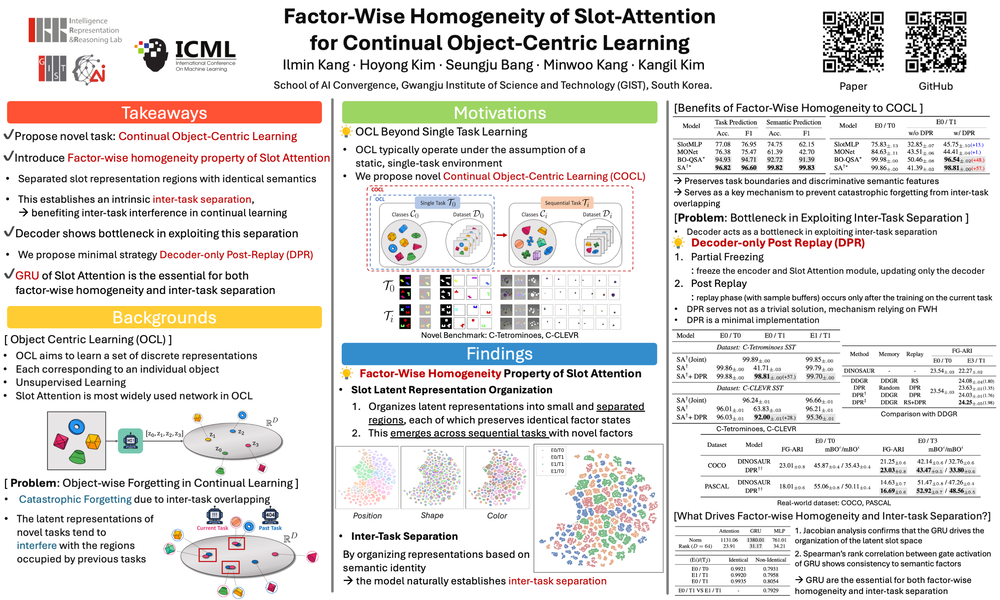
Factor-wise homogeneity in slot attention. Slot Attention organizes its latent space into separated regions that preserve identical factor states across tasks, which is a key mechanism against forgetting in continual object-centric learning (Kang et al., 2026).
These projects connect to my Neural Collapse work through a shared question: what geometry should a representation space have, and how can training be steered toward it?
References
2026
TMLR
The Impact of Enforcing Representational Consistency of Identical Transformations for Disentangled Representation
Hee-Jun Jung, Hoyong Kim, Ilmin Kang, and Kangil Kim
Transactions on Machine Learning Research (TMLR), 2026
Recent symmetry-based approaches in Variational Autoencoders (VAEs) have advanced disentanglement learning and compositional generalization. However, existing methods can encode identical semantic transformations differently depending on the specific sample pairs, which reduce the representational consistency of identical transformations. In this paper, we analyze how three commonly used symmetry parameterization families in prior work, namely (1) matrix-exponential parameterizations over the general linear group GL(n), (2) vector-additive actions in latent space, and (3) surjective mappings from latent vectors to the unit circle, can make it difficult to represent identical transformations consistently in dimension-wise disentangled latent spaces. To address this issue, we propose a framework that maps latent vectors to a bijective cyclic representation on the unit circle via the Cayley transform, together with a fixed-grid codebook regularization. We study this problem in a controlled setting and develop practical weakly supervised and supervised variants. Experiments on disentanglement benchmarks and compositional generalization tasks show that the proposed framework yields improved disentanglement performance and strong compositional generalization under supervised settings, with the stronger-supervision variants providing empirical reference points for the representational capacity of the framework. Overall, our results suggest that consistent representation of identical transformations is a useful design principle for improving disentanglement and generalization performance in the considered setting.
@article{jung2026impact,title={The Impact of Enforcing Representational Consistency of Identical Transformations for Disentangled Representation},author={Jung, Hee-Jun and Kim, Hoyong and Kang, Ilmin and Kim, Kangil},journal={Transactions on Machine Learning Research (TMLR)},issn={2835-8856},year={2026},}
ICML
Layer-Centric Factors of Variation Disentanglement for Task- and Model-Agnostic Generalization
Hee-Jun Jung, Jongmin Park, Minwoo Kang, Hoyong Kim, and 1 more author
In International Conference on Machine Learning (ICML), 2026
Disentanglement learning aims to separate the underlying factors of variation (FoV) to improve generalization. However, most FoV-based latent-vector-centric methods impose objective-driven constraints at a bottleneck, and it is difficult to translate disentanglement into consistent gains on downstream tasks without inductive bias. Motivated by architectural approaches complementary to vector-centric objectives for downstream tasks, we propose the Orthogonal Subspaces Projection (OSP) layer, a plug-and-play module that integrates into intermediate layers and promotes FoV separation by projecting latent features into mutually orthogonal subspaces. Across diverse domains and tasks, models equipped with the OSP layer improve disentanglement quality and generalization in downstream tasks, including computer vision (classification, detection, and segmentation), natural language processing (word analogy, and text classification), and fine-tuning settings on large backbones.
@inproceedings{jung2026layercentric,title={Layer-Centric Factors of Variation Disentanglement for Task- and Model-Agnostic Generalization},author={Jung, Hee-Jun and Park, Jongmin and Kang, Minwoo and Kim, Hoyong and Kim, Kangil},booktitle={International Conference on Machine Learning (ICML)},year={2026},}
ICML
Factor-Wise Homogeneity of Slot-Attention for Continual Object-Centric Learning
Ilmin Kang, Hoyong Kim, Seungju Bang, Minwoo Kang, and 1 more author
In International Conference on Machine Learning (ICML), 2026
While Object-Centric Learning has shown great promise in modular perception, its extension to Continual Learning remains underexplored. In this work, we observe that Slot Attention exhibits a distinctive behavior: it organizes latent representations into small and separated regions, each of which preserves identical factor states, crucially emerging not only in the current task but also across sequential tasks with novel factors. This inter-task separation offers significant advantages in continual learning, which typically suffers from severe object-wise forgetting. We refer to this phenomenon as Factor-Wise Homogeneity, and show that this intrinsic inter-task separation is crucial, serving as a key mechanism to prevent catastrophic forgetting in Continual Object-Centric Learning. However, despite its strong robustness, factor-wise homogeneity alone is insufficient due to the bottleneck in exploiting this separation at the decoder. To overcome this limitation and demonstrate the significance of our findings, we show that a minimal strategy, Decoder-only Post-Replay, which freezes the factor-wise homogeneous representations and employs decoder-only fine-tuning, is sufficient. This work serves as a fundamental basis for understanding and leveraging the intrinsic dynamics of Slot Attention, offering essential insights for advancing object-centric systems.
@inproceedings{kang2026factorwise,title={Factor-Wise Homogeneity of Slot-Attention for Continual Object-Centric Learning},author={Kang, Ilmin and Kim, Hoyong and Bang, Seungju and Kang, Minwoo and Kim, Kangil},booktitle={International Conference on Machine Learning (ICML)},year={2026},}